
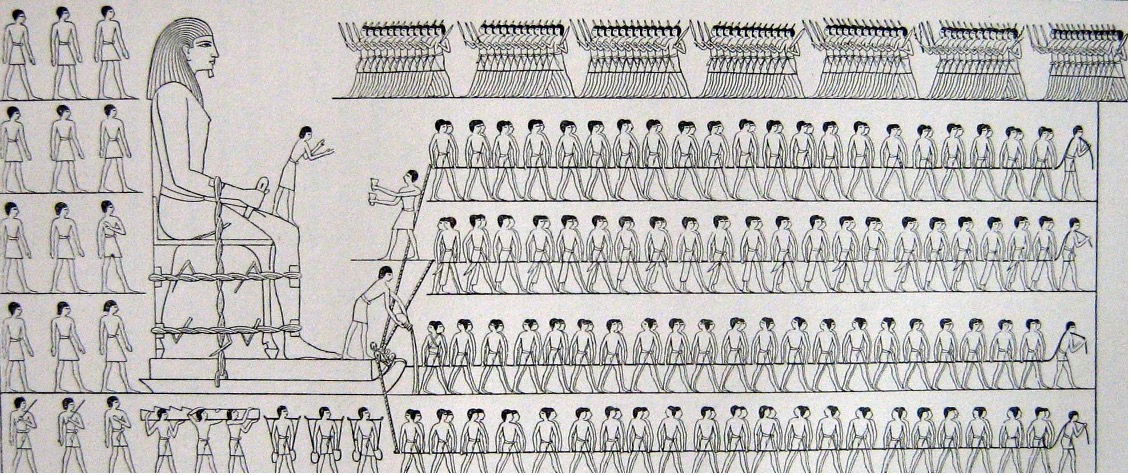
Humanity has always valued process optimisation. While many obstacles have stood in our way, one of the most prevalent challenges has always been friction. The simplest tasks can be made easier by reducing friction as any tribologist will tell you. Any activity involving movement can be improved by decreasing or increasing friction such as the transportation of goods or maintaining tools. Historians believe, for example, that early humans would remove the bark from trees to reduce friction when hauling them either for fire wood or building materials. Interestingly, the removal of the bark also led to the trees releasing sap which served as a primitive lubricant when secreted from the wood. Other examples used included mud or crushed leaves which had a similar effect when turned into a slimy consistency and applied to a substrate. Through such innovations life became far easier and allowed humans to look and more and more sophisticated methods of moving goods and building structures. Sadly, we have limited archaeological and historical evidence from the period meaning we cannot know the full extent to which lubricants became a part of daily life for early humanity.
Ancient Egyptian Innovation
It is not until the late second and early third millennia BC that more concrete evidence of lubricant research and development emerges. The Ancient Egyptians are known for being extremely advanced in many ways, but their production and use of lubricants is rarely mentioned. It must have taken much trial and error to find the right products, but the Egyptians had plenty of time to do so. The annual flooding of the Nile fertilised the land and made food production relatively easy, freeing many Egyptians to innovate in other areas.
Water
To move massive resources and monuments, the Egyptians had to think creatively—but they also embraced simplicity when it worked.
Frescoes found in ruins from the era depict water being used as a lubricant to drag colossal statues across the desert. The water reacted with the polydisperse sand and drastically reduced friction between the two substrates. This was not a new method as made clear by the use of mud by previous civilisations but never on projects of this magnitude.
Animals Fats and Organic Oils
In addition to water, the Ancient Egyptians became skilled at using animal fats and organic oils in a variety of applications. Both were popularly utilized in the production of perfumes and cosmetic products. These materials could be also used in cooking and, most interestingly, mechanical lubrication.
Countless theories exist as to how exactly the ancient Egyptians were able to construct the pyramids which still stand today. It is highly likely that the builders used lubricants. Evidence suggests that oils were utilised to lubricant large stone blocks used in the construction of temples and pyramids. The large blocks needed to be moved on and off wooden pallets to be transported and oil would have made this process far less stressful. Animal fats could also be synthesised to different consistencies depending on how long they were rendered. This would have given the Egyptians some room to experiment with different consistencies for different projects.
Lubricants were also key for transportation; the Armies of Ancient Egypt did not just rely or foot soldiers or even those on horseback. They used Chariots to overwhelm their enemies as it left their warriors free to use their hands.

Image source found here (https://www.thoughtco.com/bitumen-history-of-black-goo-170085)
Animal fats were applied to the axles of chariots to reduce friction—a simple yet effective technique. While today’s vehicles use advanced synthetic greases, the principle remains the same. This image shows Rameses the Great riding into battle, demonstrating the advantage of superior mobility and engineering.
Bitumen
The Dead Sea provided Egypt with a source of Bitumen. Found near the surface in tar lakes, this tacky black substance, a derivative of petroleum, provided many solutions for Egypt including in the mummification process. Once dried it provided protection for the bodies after burial. It was also used for waterproofing in a variety of applications including the transportation of goods.
Through trial and error, the Ancient Egyptians were even able to utilise bitumen as a form of grease for axels and other moving parts. It is unclear just how much this replaced animals’ fats as bitumen was likely a scarcer resource yet given that we still use bitumen today, it is incredible that such innovation was being used so long ago and for such a variety of tasks.
Conclusion: A Legacy of Ingenuity
Without the ingenuity of the Ancient Egyptians, we might not have the wide range of lubricants and greases available to today’s engineers. Their resourceful use of available materials—from water and organic oils to bitumen—demonstrates a sophisticated understanding of friction and motion long before the modern era.
Research and development remain just as important today as they were thousands of years ago.
Join Us at Lubricant Expo Middle East
Discover the latest trends and technologies shaping the lubrication industry at Lubricant Expo Middle East, 20–22 January 2026, in Dubai, UAE.
Our free-to-attend technical conference runs across all three days and covers the key challenges and opportunities in modern lubrication. Don’t miss this opportunity to connect with industry leaders and innovators.
Featured image source: https://en.wikipedia.org/wiki/Djehutihotep


